Mary Jane was born in 1861, Dublin, to James and Charlotte Campbell.
Mary married (Dr) Archibald Smylie in Dublin in 1883. Archibald was born in 1842 in Antrim. Their first two children James (1884) and Elizabeth (1887) were born in Dublin.
Archibald went to Sydney sometime before 1890 where he set up practice in Hunter Street. He had been admitted to the bar in Dublin and was subsequently admitted a barrister and solicitor in the Supreme Court of NSW.
In 1891 Mary and her two children arrived in Wellington from London with her mother Charlotte Campbell. Archibald must have joined them there. Mary Jane also had a brother Robert in New Zealand also, but the name makes him hard to research.
At first Archibald and Mary Jane lived in Johnsonville where Archibald recorded his profession as ‘Gentleman’. It was here their daughters Mary (1892) and Wilhelmina (1894) were born. In 1894 he was admitted a barrister and solicitor to the Supreme Court of New Zealand. He set up his practice in Featherston Street where he worked for a few years.
‘Unfortunately he was to an extent his own enemy’
In about 1897, Archibald moved his family to D’Urville Island where he has been ‘occasionally following the humble yet honest calling of a fisherman’ in the employ of H P Littlewood of Wellington. His youngest sons, the twins Robert (1897) Archibald (1897), were born on the island.
He had been returning to the island from fetching supplies one day in July 1898. It was supposed that his boat was accidentally swamped and he was never seen again. Messenger pigeons were used to communicate with the island about the search for the missing man (taking 25 minutes to arrive). The reply was that only three single boots and a sugar bag had been found, confirming that the boat had been well laden.
Mr H P Littlewood advertised in the NZ Times that Mrs Smylie has been left in a destitute condition and would be glad to receive any gifts of clothing or boots for the little ones to be sent D’Urville Island. A fundraising event was held in Thomas’s Hall and by September 1898, Mary and her four youngest children had moved back to Wellington.
The same month the Museum exhibited six live Kiwis in a glass case, purchased for the Museum from the widow of the late Dr Smylie. Five of the birds subsequently died but all were preserved for the Museum by Mr Yuile, the Government Taxidermist.
The family appeared to be separated and moved around a bit: in 1900, daughters Mary and Wilhelmina (known as Mina) were both attending New Brighton School whereas Mary was living with her mother Charlotte in Mitchelltown; in 1906 Mina won school prizes for Sunday School attendance in Carterton and her brother Robert attended Clareville School.
In 1902 Mary was fined 20s for drunkenness and again in 1911. In September 1912 she was deemed to be ‘idle and disorderly’ and sentenced to one month’s imprisonment. In December she was found to be the same again, with insufficient means of support, and sentenced to three months imprisonment. In 1914 she was again charged with drunkenness and declared ‘I am guilty, I want to go to gaol.’ The judge would fine her 10s – ‘Oh my God! Is that all?’ she exclaimed as she left the dock. She was deemed a ‘rogue and a vagabond’ which meant that she had insufficient lawful means of support. Inspector Hendrey explained that the woman was ‘homeless and friendless and had instigated the proceedings herself.’
She does not appear on electoral rolls after 1914.
In 1916 Mary’s mother Charlotte died at the Ohiro Benevolent Home where she had been living since at least 1911 and was buried in an unmarked plot at Karori Cemetery.
In 1918 Archibald and Mary’s son Robert was killed in action in France. He is remembered on the Clareville School Memorial Board.
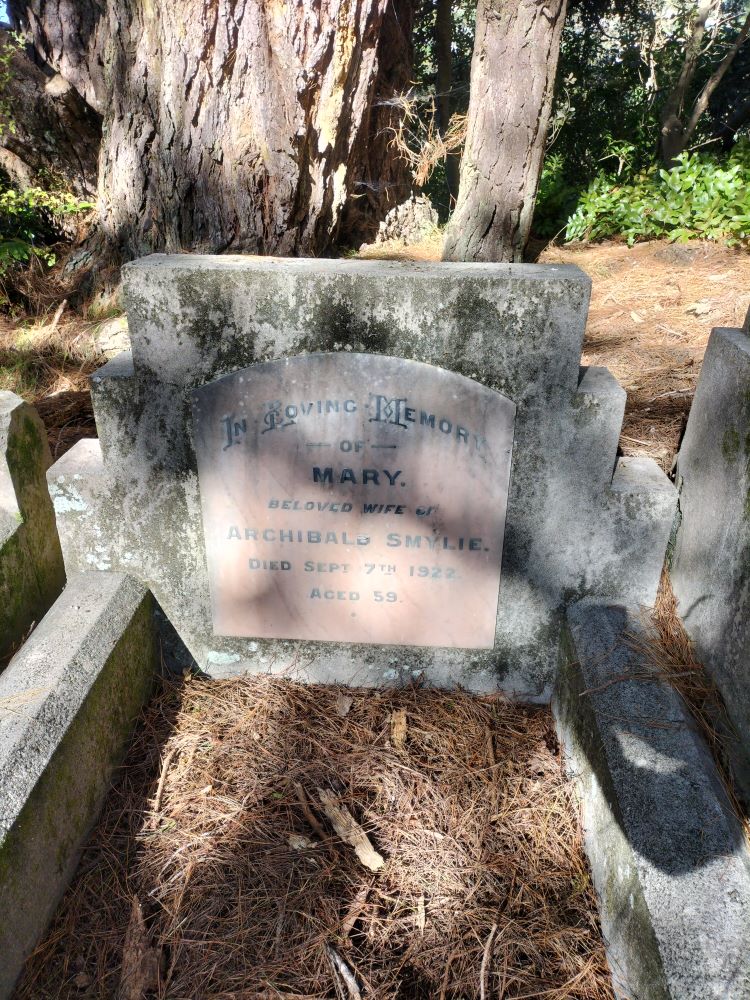
Mary died in 1922 at 194 Owen Street which was the location of the Paulina Salvation Army Rescue Home. There was no death notice. But there is a substantial headstone to remember her and Archibald.
Plot: *Public 2/N/434
By Julia Kennedy