Imperial Service Order, Fellow Royal Geographic Society
Our Great Grandfather James Stewart Mackenzie was born on March 10th 1849 in Edinburgh to David Stewart and Rebecca (nee Noble) Mackenzie. James was the eldest of a family of two boys, James and his brother Thomas and three girls Marion, Rebecca and Christina. I don’t know much about the family’s time in Scotland other than the fact that David Mackenzie was a gardener principally at Canaan House in Morningside, south Edinburgh. The Mackenzie family emigrated to New Zealand by the ship “Robert Henderson” in November 1857 arriving in Dunedin on February 9th 1858.
On his arrival in Dunedin James would have been 9 years old and he attended one of the new Otago schools formed in 1858 under the Otago District Schools scheme. This was either Wakari School or Andersons Bay School, both of which were established in 1858 and are still in operation today. He then attended Dunedin High School (now known as Dunedin Boy’s High School) as a founding student from the year the school opened in 1863.
On graduating from high school James decided to pursue a career in surveying, New Zealand being a new land with such a vast amount of unexplored and uncharted territory. His first experience of fieldwork was under the tutelage of Mr John Cameron a prominent staff surveyor for the Otago Provincial Government who was responsible for training several pioneer surveyors. Cameron himself became prominent in managing major mapping and settlement operations in the Otago region before New Zealand’s provinces were abolished in 1876. James assisted in the survey of the new town of Palmerston to the north east of Dunedin established to act as a service hub on the route to the Central Otago goldfields.
During his early surveying career James took part in two particularly gruelling expeditions to the South Island’s west coast. The first of these was an ill-fated expedition to Preservation Inlet in the west of present day Fiordland to lay off an area of known coal reserves. The expedition was made up of 5 trainee surveyors including James and was led by James mentor John Cameron. The team were delivered to Preservation Inlet by the SS Airdale on July 28th 1868 and, along with two rowing boats were left there to conduct their survey. On Friday August 14th Mr Cameron and members of his team were out shooting, perhaps to supplement their supplies with fresh game, when Mr Cameron’s fowling piece exploded shattering the bones in his forearm. As there was not much the team could do to treat him on the spot and with the wound becoming more and more gangrenous by the day it was decided to row him around the coast to Invercargill for treatment at Southland Hospital. After a gruelling 4 days they made it to Riverton and thence by road overland to Invercargill. Unfortunately it was too little too late and John Cameron died of his wounds on the morning of Saturday August 22nd 1868.
The second major expedition James took part in was in 1870 when he joined a survey party whose task was to map out the proposed town of Jamestown on the shores of Lake McKerrow near Martins Bay on the Otago west coast. Martins Bay is approximately 320 kilometers south of Hokitika adjacent to the Hollyford River and the present day egress of the Hollyford Track. The appeal of Otago’s gold rush had been diminishing and the Otago Provincial Council needed a scheme to breath life into a flagging economy and population. The very zealous Provincial Superintendent, James Macandrew, was very keen on this western expansion even to the extent of ignoring an earlier cautionary report on the idea by provincial surveyor W G Wright. The survey team James was part of as a survey cadet departed Dunedin aboard the 89 ton paddle steamer “Charles Edward” on February 21st 1870 for Martins Bay via Bluff. The team was under the charge of Samuel Thompson and John Strauchon. Once the settlement at Jamestown was established it was intended to attract settlers by offering land under the Crown Grant System however the visions of a thriving settlement were not realized. Jamestown’s population peaked at a mere 50 in 1871 but extreme remoteness, thick bush, very inclement weather and lack of regular supply vessels made survival a constant struggle and by 1882 Jamestown was all but deserted.
James qualified as a surveyor in 1871 and was appointed Assistant Surveyor for Wellington Province in 1872. He seems to have progressed quickly through the grades being appointed District Surveyor in 1874 and Chief Draughtsman and Office Surveyor for Wellington in 1879. The Hawera & Normanby Star for December 28th 1901 announced James promotion to the position of Commissioner of Crown Lands and Chief Surveyor for Taranaki. In this promotion he succeeded an old colleague John Strauchon who was appointed to the position of Commissioner of Crown Lands and Chief Surveyor for Wellington.
In Wellington James married Margaret Elizabeth Wilmor McKenzie on June 28th 1876. They had two daughters Hilda (1878) and Lilian (1880) and a son David (1882). Sadly Margaret died on September 9th 1884 at the young age of 30. Three years later on August 3rd 1887 James married Annie Elizabeth Wilson at St Mary’s church in Timaru. Annie was the daughter of the celebrated Timaru architect Francis John Wilson who many consider to be the saviour if the township following the December 1868 fire that devastated the Timaru CBD. F J Wilson was responsible for designing and seeing to fruition all of the replacement stone and brick buildings that replaced Timaru’s initially wooden business centre. Annie and James were to extend the Mackenzie clan with three daughters, Margaret Kathleen Annie (1887), Katherine Elsie Lynette (1891 – our Grandmother), Jean Elizabeth (1893) and two sons Ronald Francis Wilson (1889) and James Alan (1895).
On May 19th 1904 the Evening Post announced that Mr Gerhard John Mueller, the Assistant Surveyor General and Commissioner of Crown Lands for Auckland, was to retire “…by reason of age…” after nearly 40 years service in the department. The newspaper went on to state that “…the vacancy created will be filled by Mr James Mackenzie, Commissioner of Crown Lands for Taranaki…”. The article also explains who would backfill for whom in this nation-wide shuffling of appointments within Lands & Survey.
James spent 4 years as Commissioner of Crown Lands for Auckland before being appointed back to Wellington as Commissioner of Crown Lands for Wellington in early May 1908. In March 1912 James was appointed Surveyor General, once again following his old colleague John Strauchon whose progress through the ranks he was mirroring almost step by step. On vacating the position now filled by James, Mr Strauchon was appointed Under-Secretary for Lands followed by his retirement on March 31st 1914. James followed him into the role of Under-Secretary, effective April 1st 1914, and soon afterwards in June 1915 he also retired after 49 years of public service. Both men in their turn were awarded the Imperial Service Order, John in the Kings Birthday Honours for June 1912 and James in the Kings Birthday Honours for June 1915.
James and his brother Sir Thomas Mackenzie – member of parliament (Clutha), one time Prime Minister in 1912 and New Zealand High Commissioner In London 1912-1920 – purchased a considerable amount of land in eastern Karori in the vicinity of Old Karori Road and modern day Rosehaugh Avenue and Seaforth Terrace, both named by James. This property was a portion of the land previously owned by early settler Timothy Benton who on-sold the land to the brothers in 1878 and 1879 a holding which they supplemented with land purchased in 1890 and 1892 from Mrs Frances Standen, the widow of Edward Standen and daughter of Timothy Benton. James built a family home on the land he named “Rosehaugh” after the “Rosehaugh Estate in Avoch, Ross-shire, Scotland which had deep ancestral ties to his family’s Scottish heritage.
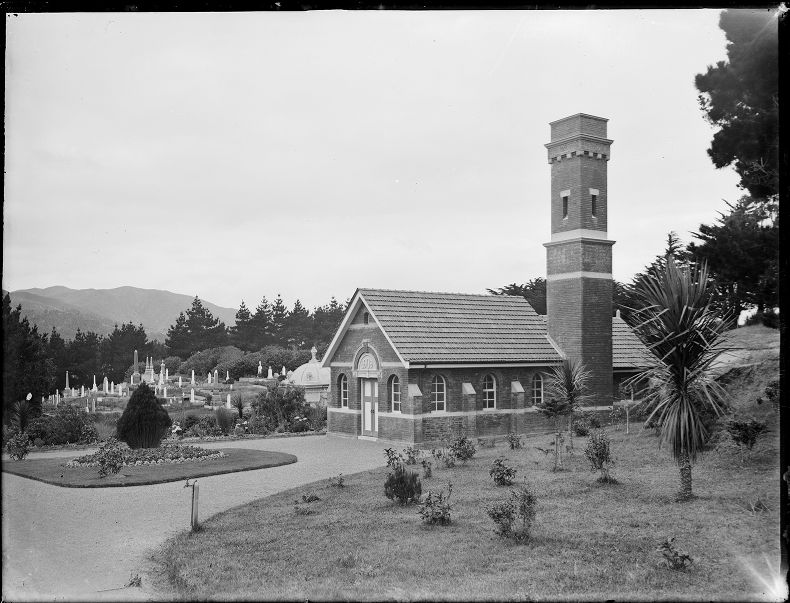
In the late 1900’s Wellington City Council was in need of new land to establish a cemetery as those now within the city boundaries were reaching capacity. The New Zealand Cemeteries Act of 1882 stipulated that new cemeteries could not be established within the boundaries of towns or boroughs forcing Wellington to look outside its city limits which in those days meant Karori among other locations. A number of sites were proposed by their owners and, through a process of ballots, this number was whittled down until the land offered by the Mackenzie brothers was accepted as the site for the new Wellington City Cemetery. Ongoing negotiations around price per acre and the establishment of access roads were soon settled and the first regular burials began in February 1892.
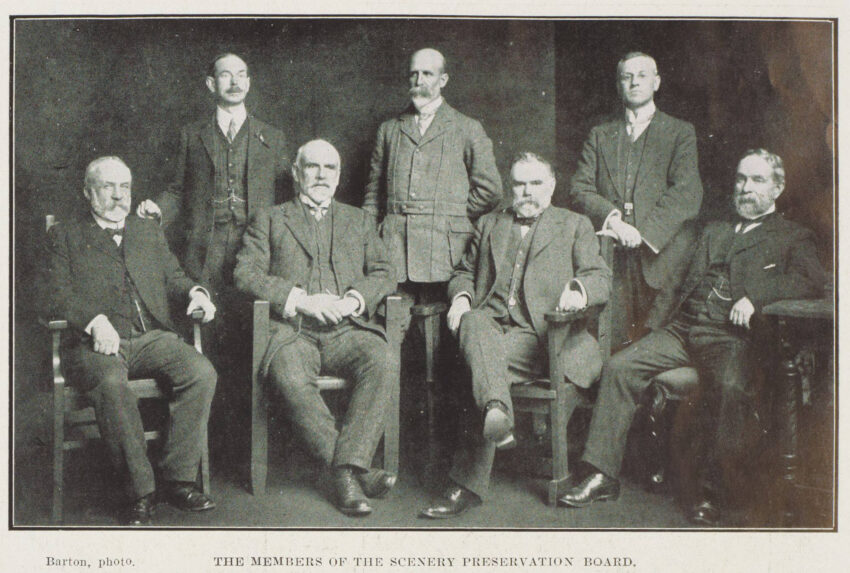
James retired at the end of June 1915 in his 66th year and after 48 years with of service to New Zealand. The Wairarapa Age for April 24th 1915 stated that he “…will retire on superannuation…”. James was always community and service minded and as a long time resident of Karori in Wellington’s western hills he supported his community by serving as a member of the Karori Borough Council, chairman of the local school committee for 13 years, presided over school functions and assisted in securing local educational resources. More widely than in his immediate community James was a member of the North Island Representation Commission for determining electoral boundaries between 1901 ans 1908; he served as a School Commissioner for the three districts where he was stationed as Commissioner of Crown Lands; he was chairman of the New Zealand Surveyors Examination Board; chairman of the Scenery Preservation Board for New Zealand and a member of the Land for Settlements Purchase Board, the Native Land Purchase Board, the State Advances board and the Public Trust and Government Insurance Board. A busy life.
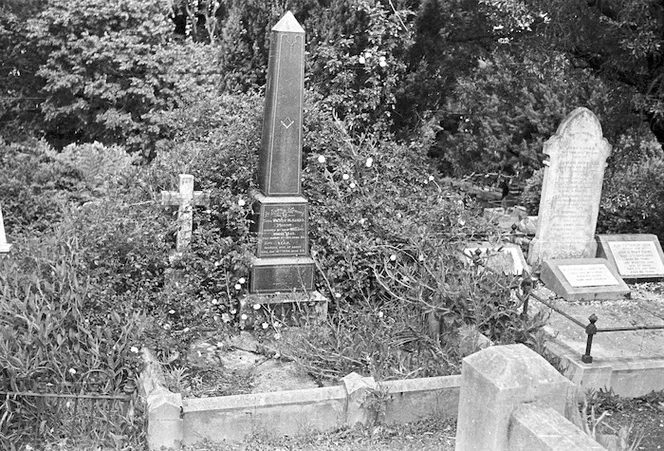
James died in his 79th year on August 9th 1928. He was cremated at Karori and left instructions in his will that his ashes be “…placed in an urn and be buried in the grave of my first wife in the Sydney Street Cemetery, Wellington…”. The grave marker, a tall plinth in gray polished granite marked with inscriptions commemorating various members of James in-laws family – his first wife and his father-in-law among them – remains today at plot N15 04 of Bolton Street Cemetery.
By Peter Wells
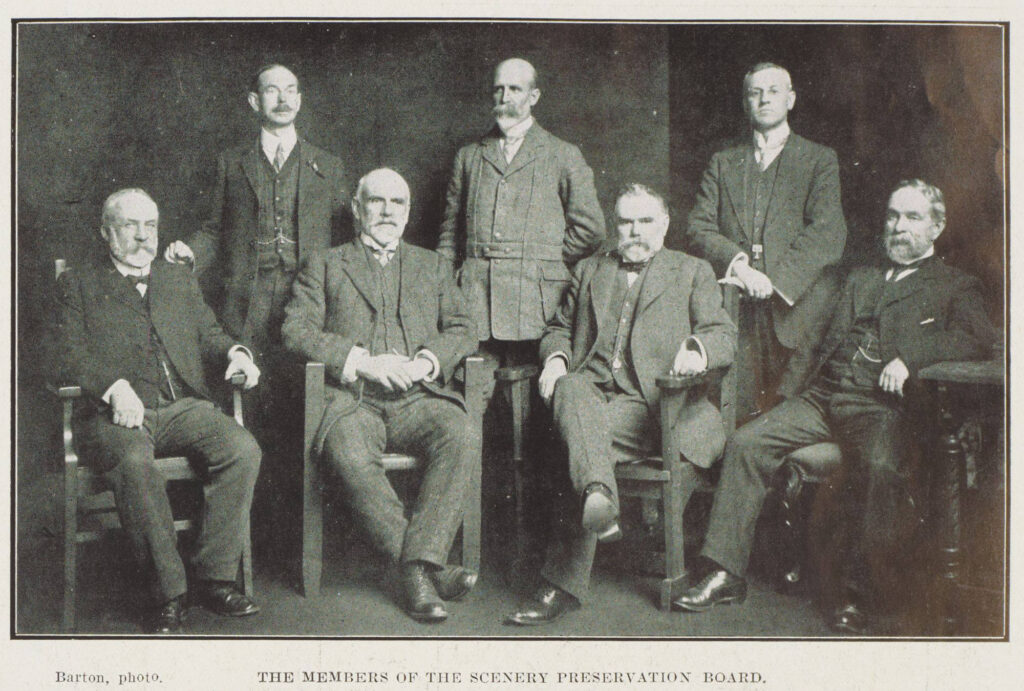
Portrait of the members of the Scenery Preservation Board. BACK ROW, from left: Messrs W.R. Jourdain; E. Phillips Turner; F.S Pope. FRONT ROW: T.W. Fisher; James Mackenzie; T. Mackenzie; J. Strauchon. Courtesy of Auckland Libraries Heritage Collections NZG-19120717-0019-02.