
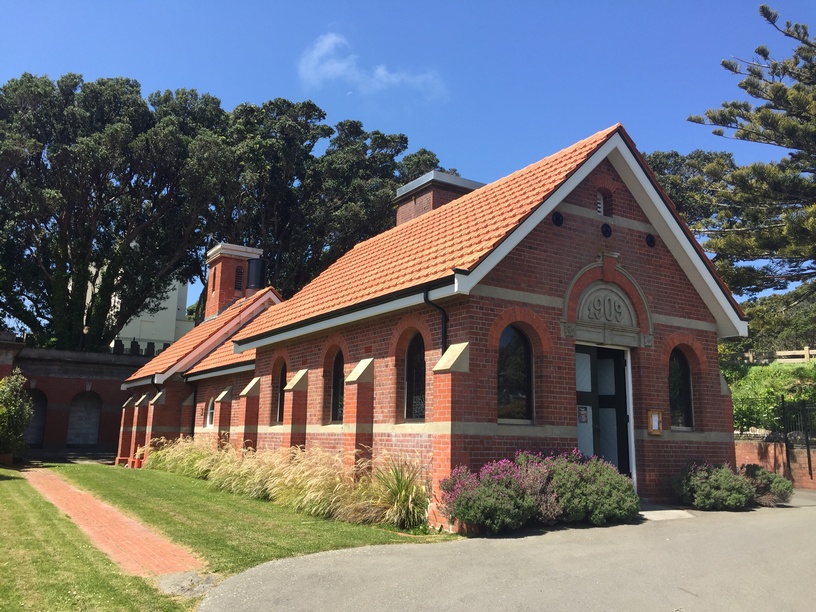
Built in 1909, the brick built crematorium and chapel are in the Edwardian-Romanesque style and is the earliest crematorium facility in New Zealand. It is a Historic Place Category I.
Proposals for cremation in Wellington date back to at least 1888 when William Ferguson (engineer and secretary of the Wellington Harbour Board) suggested that an additional furnace be added to the planned City Destructor (a rubbish disposal facility) for this purpose. While there was some support, this was not actioned.
The turning point came in 1906 with a campaign led by Miss Studholme on public health grounds. The original plan from John Sidney Swan was for a Gothic timber-style building. The City Engineer William H Morton was unhappy with the proposal of a timber building surrounding a high temperature furnace and so drafted an alternative building in brick.
Cremations made up just 1.3% of all disposals in the first year. It wasn’t until the 1930s that cremations seriously rivalled burial as a means of disposal.
The first ashes were installed in the chapel and after those niches were filled, cavities were built in columbaria outside from 1937 onwards.
The new chapel on Rosehaugh Avenue was opened in 1960 to provide more adequate space for mourners.
Stained Glass Windows
The stained glass windows in the Chapel are considered to be the most important twentieth century imported windows of their kind in New Zealand. Five of the windows commemorate members of the Ferguson family, including the same William Ferguson who ordered five of the seven windows from Dublin.
An Túr Gloine The Tower of Glass
The founding of An Túr Gloine Studio in 1903 was a consequence of the Irish Revival and Arts and Crafts Movement in stained glass. It was a purpose-built, cooperative studio based in Dublin, Ireland. Three of the eight principal artists of An Túr Gloine are represented by their work in this chapel.
The studio is regarded as part of the Art and Crafts movement but was also infused with Irish revivalism and drew on the artistic tradition of Celtic manuscript illumination.
As a set, the windows span the best period of An Túr Gloine’s manufacture of stained glass and were digitised to harmonise with each other.
Artists
Wilhelmina Geddes (1887-1955)
Geddes studied at the Belfast School of Art, Ulster University and joined An Túr Gloine in 1910. Her work was considered pioneering and represented a rejection of the Late Victorian approach. Herconographic sources were eclectic and included features of Romanesque sculpture and Medieval stained glass. ‘Faith’ and ‘Hope’ in the chapel are probably only Geddes’ seventh or eight windows, and there are only two other specimens of her work outside the United Kingdom and Eire.
Further reading on this Irish Times link.
Michael Healy (1871 – 1941)
Healy trained at the Dublin Metropolitan School of Art. He was a member of An Túr Gloine from its inception, working there for the rest of his life.
Hubert McGoldrick (1897-1967)
McGoldrick worked at An Túr Gloine from 1920 until 1945 when the cooperative dissolved, and so his window is an example of the late style of this group.
Faith
for Jane Ann Moorhouse
the mother of William Ferguson’s wife, Mary
1914. Artist: Wilhelmina Geddes
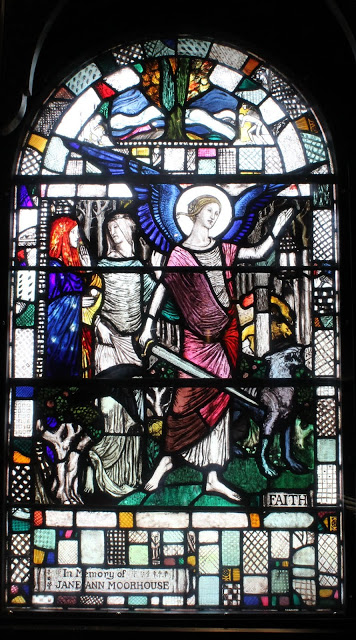
This window depicts a sword-bearing Angel of Faith, leading a woman safely through a forest inhabited by wild beasts and a raven, and a red-haired temptress. At the top are vignettes of Moses in the bulrushes and Moses as overseer in Egypt.
Her apprehensive companion, one hand raised in shock, the other holding a single white daisy, a symbol of Innocence, represents Chastity.
The mostly abstract, painted border beside Chastity’s head includes a praying mantis and splashes of ruby, drawing attention to the ominous blood-red pool where the lion lurks, deep in the wood.
Geddes inclusion of ominous crows and zoomorphic images references early Irish decorative motifs.
Hope
for Louisa Ferguson, William and Mary’s daughter who died as a child
1914. Artist: Wilhelmina Geddes
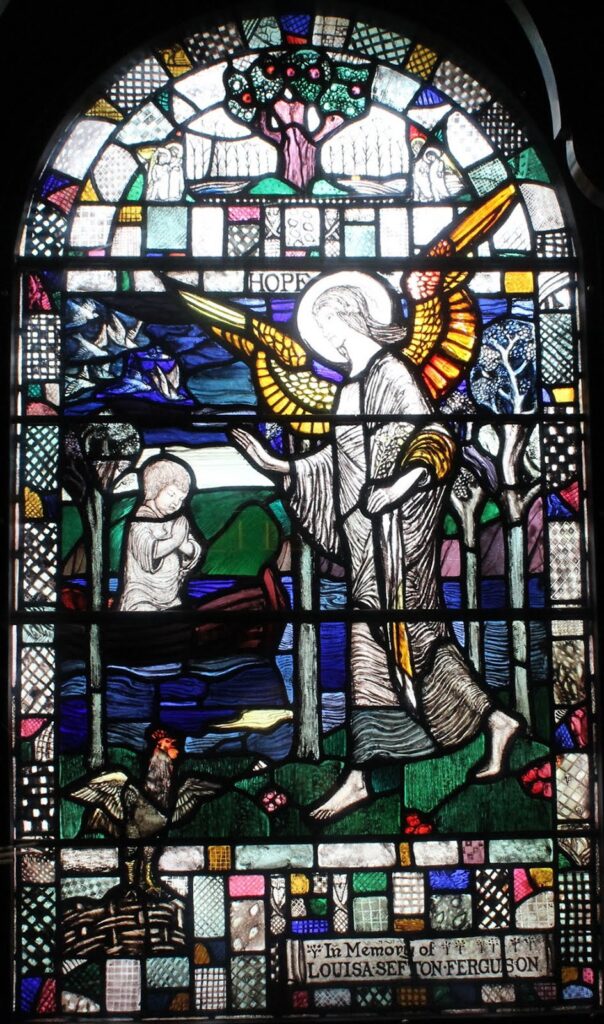
This window has a much gentler Angel of Hope, waiting to greet a child in a boat, who is ‘crossing over’, surrounded by doves – the young Louisa presumably.
Hope approaches the water’s edge through a flowery meadow, one hand raised in blessing, the other holding long sheaves of corn, an attribute of the Greek goddess Demeter, protectress of earthly fruits and mother of Persephone, who ‘rules over the souls of the dead’.
The red-combed cock alludes to the traditional association of the crowing cock with Christ, a symbol of hope at the break of day and a harbinger of dawn and resurrection as the child’s soul enters a new life in Paradise.
Charity
for William Moorhouse MBE, Mary Ferguson’s brother and son of Jane and William Sefton Moorhouse, a former Superintendant of Canterbury and Mayor of Wellington
1930. Artist: Michael Healy
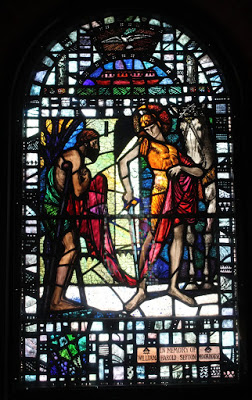
This window depicts St Martin of Tours as a young officer giving half of his cloak to a beggar, and above, the Ark in the Flood.
Love
for Mary, William Ferguson’s wife
1931. Artist: Michael Healy
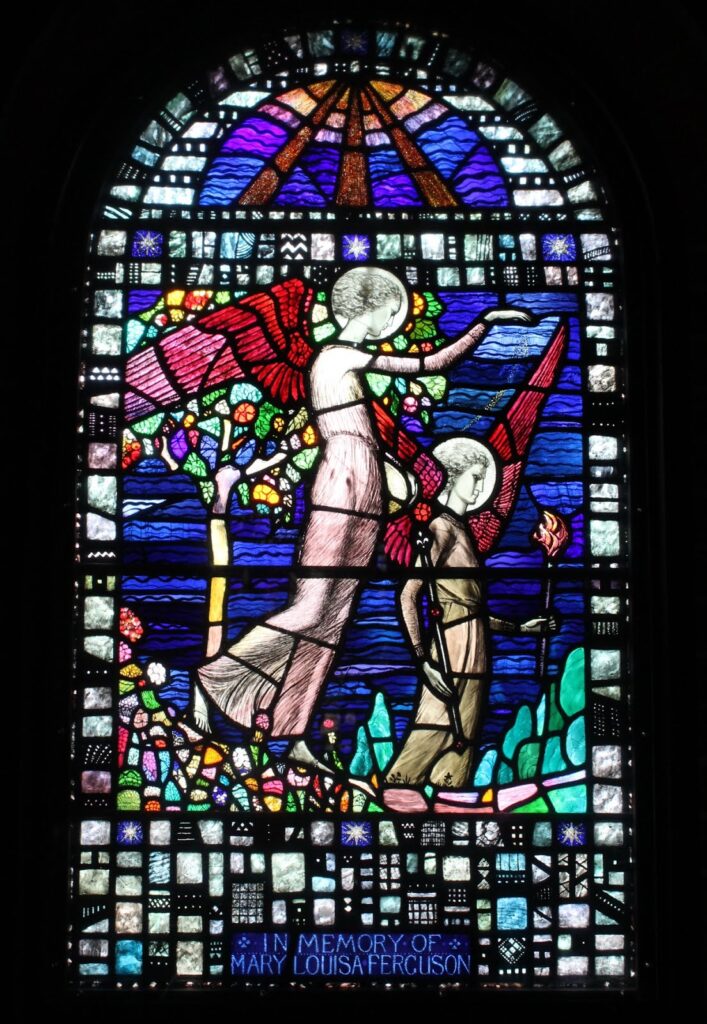
In a paradisal garden two angels stroll, one carrying a flaming torch and sceptre and the other strewing golden dust. This window attests to Healy’s great skills as a colourist and acid-etcher. The flowers and tree feature unusual juxtapositions of brightly coloured glass in a manner which could be viewed as one of the distinguishing characteristics of Irish stained glass
Wisdom
in memory of William Ferguson
1937. Artist: Michael Healy
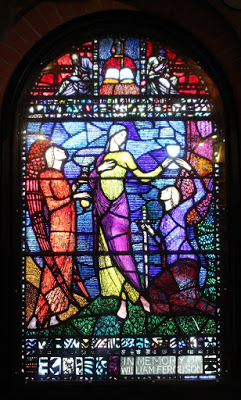
In this window Wisdom. assisted by an angel with a goblet and flask, passes a cup to a kneeling figure with a sword. At the top, two figures sit reading on either side of an open volume with Chapter 8:4 from the Acocryphal Book of Wisdom on it.
The jewel-like effects on the drapery, wings and background have been achieved through deep and extensive acid etching on flashed glass.
The window ‘Wisdom’ is signed in Gaelic – Healy did not usually sign his windows so this makes it rare. This window also has acid etching on flashed glass (glass with two layers malted together; one is coloured and the other can be clear or colours), a technique which Healy used only occassionally.
Gethsemane
a memorial to James McRae and Percival Parr
1937. Artist: Hubert McGoldrick
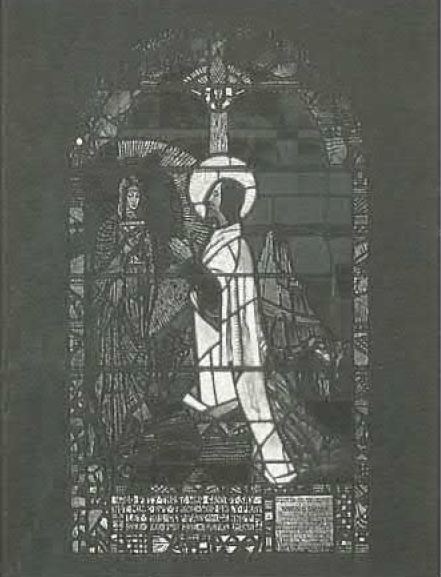
This window depicts Christ’s agony in the garden. In the distance Judas leads the soldiers to capture Christ.
McGoldrick’s work is more angular in style than that of Geddes and Healy.
Sources:
Karori Cemetery Conservation Plan prepared by Four Decades Conservation for the Wellington City Council, June 2003
Karori Crematorium and Chapel Heritage New Zealand List Entry Information retrieved from www.heritage.org.nz
Bowe, Nicola Gordon, (2015) Wilhelmina Geddes Life and Work, Dublin: Four Courts Press
Ciarán,Fiona (1987). Treasures in Karori. Crafts Council Magazine, 28-30. Retrieved from www.christchurchartgallery.org.nz
Prepared by Friends of Karori Cemetery August 2020